 Available in US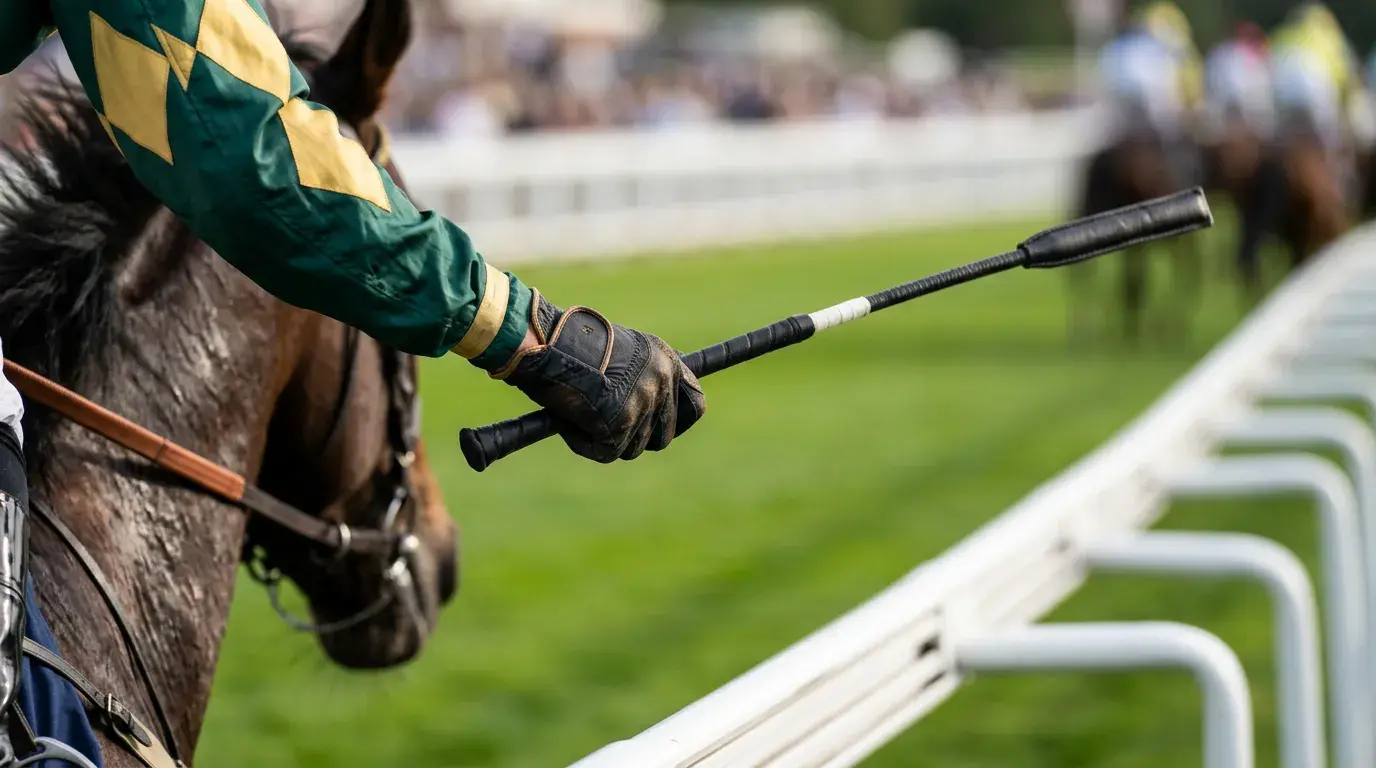
British racing’s whip rules underwent significant reform in early 2023, introducing stricter limits and harsher penalties than any previous regime. These changes emerged from extensive consultation following sustained public pressure about horse welfare, reshaping how jockeys ride finishes and, crucially for bettors, creating new grounds for disqualification that can overturn results after the finish line.
For punters, understanding whip regulations has become essential rather than optional. The 2024 Cesarewitch provided a stark illustration: the first horse past the post was subsequently disqualified for whip violations, redistributing prize money and settling bets on an entirely different outcome. Such scenarios, while rare, carry enormous financial implications for anyone holding tickets on affected runners.
The rules that protect fairness and welfare operate through clearly defined strike limits, graduated penalties, and a disqualification threshold that removes winning horses from results when violations become severe. This article explains the current framework, examines how it applies across different race types, and outlines what bettors need to know about potential post-race amendments.
Current Whip Regulations
The British Horseracing Authority implemented its current whip rules in February 2023, replacing a previous system that many considered insufficiently deterrent. The new framework establishes clear numerical limits, defines acceptable use patterns, and creates meaningful consequences for violations.
Under current BHA regulations, jockeys may use the whip a maximum of six times during a flat race and seven times during a jump race. These limits apply to the entire race, not merely the closing stages, requiring jockeys to manage their whip use strategically throughout. The additional strike permitted in jump racing acknowledges the longer distances and different dynamics involved when horses negotiate obstacles.
Beyond raw numbers, the rules specify how strikes must be delivered. The whip should only contact the horse in the backhand position—striking with the forehand is prohibited regardless of force. Jockeys must allow the horse time to respond between strikes; rapid consecutive use constitutes a separate violation even if total strikes remain within limits. The arm must be raised no higher than shoulder height, and the whip should never be used on a horse that is clearly winning, has stopped trying, or is out of contention.
The padded whip itself meets strict specifications. Modern racing whips feature energy-absorbing padding designed to minimise impact while remaining effective as directional aids. The BHA has approved specific whip designs; using non-compliant equipment constitutes an offence separate from any misuse violation.
These regulations apply uniformly across all British racing—from maiden races at minor meetings through to Group 1 contests at Royal Ascot and heritage handicaps like the Cesarewitch. No exception exists for prestigious races or high-stakes finishes. A jockey exceeding limits in a two-horse photo finish faces identical consequences to one doing so in an uncompetitive handicap.
The rules also address what happens between strikes. Jockeys must give horses time to respond—the so-called “response time” requirement. Mechanical, repetitive striking without allowing reaction constitutes improper use regardless of total count. This provision recognises that welfare concerns extend beyond simple numbers to include the manner and rhythm of whip application.
Strike Limits by Race Type
The distinction between flat and jump racing limits reflects practical differences in how races unfold. Flat races typically last between one and four minutes, limiting opportunities for whip use. Jump races extend considerably longer—a Grand National takes over ten minutes—creating more situations where encouragement might reasonably occur.
The six-strike flat limit applies to all races on the level, from five-furlong sprints through to marathon handicaps like the Cesarewitch. Distance variations within flat racing do not affect the limit. A jockey in a two-mile-two-furlong handicap has no more strikes available than one contesting a minimum-trip dash. This uniformity simplifies enforcement and prevents arguments about distance-based exceptions.
Jump racing’s seven-strike allowance covers hurdles, steeplechases, and National Hunt flat races. The additional strike acknowledges that horses sometimes need encouragement after jumping errors or when facing fences at challenging points in races. However, the same proportionality applies: seven strikes must cover the entire race, whether a two-mile hurdle or a four-mile-plus cross-country chase.
BHA data reveals that seventy-six percent of whip rule violations in 2023 involved exceeding the limit by just one strike—seven on the flat or eight over jumps. This concentration suggests jockeys generally understand the limits but occasionally misjudge in competitive finishes. The marginal nature of most breaches influenced the penalty structure, with single-strike violations drawing lighter sanctions than more substantial excess.
David Jones, who chaired the whip consultation steering group, described the process that produced these rules: “An extremely thorough consultation was carried out in 2021 and 2022, followed by an extensive technical discussion phase after the publication of the recommendations. Efforts were taken to listen to the views of jockeys from both codes, over many hours. This consultation has arguably been the most thorough undertaken by the BHA in relation to any specific regulatory reform.”
That thorough consultation produced rules that balance welfare concerns against competitive integrity. The limits are restrictive enough to minimise unnecessary whip use while permitting jockeys legitimate tools for encouraging horses in genuine finishes. Where that balance ultimately settles remains subject to ongoing debate, but the current framework represents considerable evolution from previous, looser standards.
Penalty System for Violations
The BHA’s penalty framework operates on a graduated scale, with consequences escalating based on the severity and frequency of violations. Minor breaches attract suspensions and fines; serious violations can result in disqualification of the horse and lengthy bans for jockeys.
Single-strike violations—exceeding the limit by one—typically result in short suspensions, often two to four days depending on circumstances. These penalties inconvenience jockeys without devastating their careers, creating deterrent effect while acknowledging the marginal nature of the breach. Fines accompany suspensions, with amounts scaled to the race’s prize money.
More substantial violations attract proportionally harsher treatment. Exceeding limits by two or three strikes brings longer suspensions, typically a week or more. The jockey’s recent history factors into sentencing: repeat offenders face enhanced penalties reflecting their failure to adapt behaviour despite previous sanctions.
The disqualification threshold represents the most significant change in the 2023 reforms. A horse is disqualified when its jockey exceeds the permitted strikes by four or more—meaning ten strikes on the flat or eleven over jumps. This threshold was carefully calibrated: severe enough to constitute clear abuse requiring result amendment, yet distant enough from the limit that accidental breach remains virtually impossible. Jockeys reaching disqualification territory have made conscious decisions to continue striking well beyond permitted levels.
Despite approximately sixteen thousand races annually in Britain, disqualification for whip offences remains exceptionally rare. According to the BHA, in around 16,000 races there have been only three disqualifications of winning horses for whip-related offences since the new rules took effect—demonstrating that the threshold genuinely captures only egregious cases. The 2024 Cesarewitch provided one of the most prominent examples of this sanction in practice.
For bettors, the penalty system’s key implication involves understanding when results might change. Standard violations produce only jockey sanctions; the horse’s placing remains unaffected, and bets settle as normal. Only violations reaching the four-strike excess trigger potential disqualification, and stewards announce such decisions rapidly after racing. Bettors watching a close finish should note obvious excessive whip use, as it may presage result amendment regardless of what the judge’s photograph shows.
