 Available in US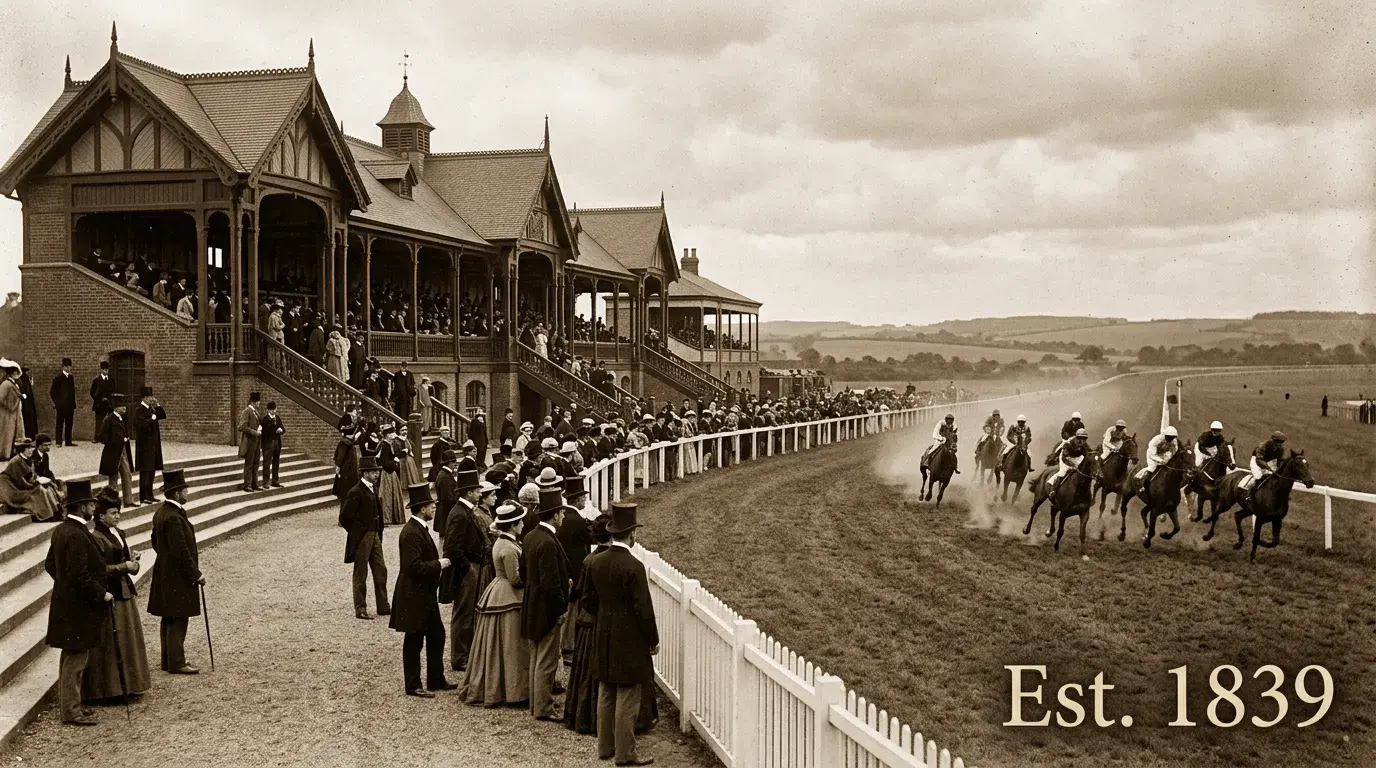
British racing possesses no shortage of heritage events, but few bear names quite as distinctive as the Cesarewitch. The word itself confounds English speakers unaccustomed to Russian honorifics—is it Cezarevitch? Cesarewich? The modern spelling reflects an anglicised rendering of a title that once designated the heir to the Russian throne. That a race named for a future Tsar should become one of autumn’s defining betting heats speaks to the peculiar path racing history sometimes follows.
First contested in 1839, the Cesarewitch predates many institutions we consider eternal fixtures of British racing. It arrived before the first running of the Grand National in its current form, before photography captured winners at the finish, before railways fully connected Newmarket to the capital. Nearly two centuries later, the race remains a central feature of the October programme, its marathon distance and massive field continuing to test horses exactly as it did when Victoria occupied the throne.
Examining how the Cesarewitch came to exist—and how it has adapted across radically different eras—reveals something about the sport’s capacity for preservation. A race named for a future Tsar survives world wars, Russian revolutions, and wholesale transformations of British society. The roll of honour stretches back nearly two hundred years, each winner adding another line to a continuous narrative that connects present-day punters to their Victorian predecessors.
The Tsarevich Connection
In 1839, the young Grand Duke Alexander Nikolaevich—Tsarevich of Russia and future Tsar Alexander II—visited England. Such royal visits carried enormous diplomatic significance in an era when monarchies still dominated European politics. The twenty-one-year-old heir arrived as part of his extended European tour, meeting Queen Victoria and touring the sights expected of a prince completing his education in statecraft.
Newmarket, already established as the headquarters of English racing, received the Tsarevich among its other distinguished visitors. The Jockey Club, eager to commemorate the occasion, proposed a new race in the heir’s honour. The timing proved fortuitous: autumn offered space in the calendar for a long-distance handicap, and aristocratic enthusiasm for racing meant the project attracted substantial backing.
The inaugural Cesarewitch ran in October 1839, its name deliberately choosing an anglicised spelling that English tongues could manage. The original distance differed from today’s specification—early runnings covered two miles and a quarter before settling into the current two miles and two furlongs. Prize money reflected contemporary values, modest by modern standards but significant enough to attract quality fields.
The young Tsarevich himself apparently showed genuine interest in racing during his English sojourn. Contemporary accounts describe him attending various fixtures and expressing appreciation for thoroughbred breeding. Whether he ever backed a winner at Newmarket remains unrecorded, but his name became permanently attached to the autumn calendar.
Twenty-two years after the race was named in his honour, Alexander became Tsar Alexander II, the reformist monarch who would abolish serfdom in Russia and modernise the empire’s institutions. He ruled until 1881, when assassination cut short his reign. By then, the Cesarewitch had established itself firmly in British racing, its origins in diplomatic courtesy long transcended by its sporting significance.
The naming convention followed established practice. British racing frequently honoured foreign royalty and dignitaries through dedicated races, a form of soft diplomacy that cost little while generating goodwill. That the Cesarewitch outlasted the Russian monarchy itself—surviving the 1917 revolution that ended Romanov rule—demonstrates how race names become detached from their original contexts, persisting through historical transformation.
The Russian Imperial Link
The title “Tsarevich” designated the eldest son of the reigning Tsar—specifically, the heir apparent to the Russian throne. In diplomatic protocol, the Tsarevich ranked among the most significant figures in European royalty, second only to crowned monarchs themselves. His 1839 visit to England reflected Russia’s desire to strengthen ties with Britain, a relationship that would fluctuate dramatically over subsequent decades.
Racing’s commemorative races served broader functions than simple entertainment. By honouring the Tsarevich, the Jockey Club signalled British regard for Russian interests at a moment when imperial competition increasingly shaped European politics. The gesture cost nothing beyond the prize money, yet it attached Russian prestige to British sporting culture. Similar motivations produced races named for other foreign dignitaries throughout the Victorian era.
Alexander’s subsequent reign as Tsar Alexander II brought contradictions that his English admirers might not have anticipated. He liberated Russia’s serfs in 1861—a reform that earned him the epithet “Liberator”—yet also presided over harsh repression of dissent. His assassination by revolutionaries in 1881 shocked Europe and intensified autocratic reaction in Russia under his successors.
By the time the Romanov dynasty fell in 1917, the Cesarewitch had already run for nearly eighty years. The race continued through the First World War, though with reduced fields and prize money. When revolution transformed Russia from empire to communist state, nobody proposed renaming the Cesarewitch. The word had become attached to the race itself rather than to any living connection with Russian royalty.
This detachment from origins characterises many racing institutions. The Derby honours a long-dead Earl. Ascot’s royal connections derive from monarchs centuries gone. In nearly two hundred years of Cesarewitch history, no winner has ever defended their title successfully the following year—a statistical oddity that speaks to the race’s difficulty rather than any imperial curse. Names persist; the contexts that produced them fade into historical curiosity.
Evolution Through 186 Years
The Cesarewitch has undergone continuous adaptation while maintaining its essential character. The marathon distance has varied slightly over the decades, settling at two miles and two furlongs—a trip that remains among the longest on the flat racing calendar. This distance positions the race as a genuine stamina test, attracting a distinct type of horse rather than the speed specialists who dominate shorter events.
Prize money trajectories reflect British racing’s broader financial evolution. Victorian prize funds seem negligible by modern standards, but they attracted fields of quality appropriate to their era. The twentieth century brought gradual increases, punctuated by inflationary spikes and occasional retrenchments. Today’s Cesarewitch carries prize money that would have seemed fantastical to nineteenth-century participants, though entry fees and training costs have scaled proportionally.
The race’s position in the calendar has proven remarkably stable. October meetings at Newmarket have hosted the Cesarewitch throughout its history, the autumn timing suiting the stamina demands that the distance imposes. Horses require full seasons to build the fitness necessary for two miles and two furlongs; the October date allows time for this preparation.
Field sizes have expanded dramatically. Early runnings attracted handfuls of runners; modern Cesarewitches regularly fill to their maximum of thirty-four. This expansion reflects both broader ownership patterns—more horses in training means more potential entrants—and the race’s betting appeal. Large fields create uncertainty that bookmakers and punters alike find attractive, ensuring market interest that sustains prize money growth.
The handicapping system itself has evolved. Early handicaps relied on subjective assessment by racing officials; modern ratings derive from sophisticated analysis incorporating time, margins, and performance data. Yet the fundamental principle remains unchanged: allocate weight so that each runner theoretically possesses an equal winning chance. That this theory rarely matches reality—light weights demonstrably outperform their heavier-burdened rivals—creates the edges that bettors seek.
What persists across nearly two centuries is the Cesarewitch’s capacity to produce upsets. Favourites fail; outsiders triumph; form students tear up their calculations. The race refuses to be solved, its thirty-four-runner fields generating sufficient chaos to defeat systematic approaches. Perhaps this explains its endurance better than any historical narrative: the Cesarewitch remains compelling because it remains genuinely difficult, its outcomes uncertain enough to sustain interest generation after generation.
The 2026 edition will mark the 187th running, another line in a record stretching back to the year a Russian prince toured Newmarket. Whatever happens when the stalls open, the race will continue adding chapters to a story that has outlasted empires, survived world wars, and adapted through technological revolution. The Cesarewitch endures because it provides what racing audiences perpetually seek: drama, uncertainty, and the possibility that today’s result might surprise everyone.
