 Available in US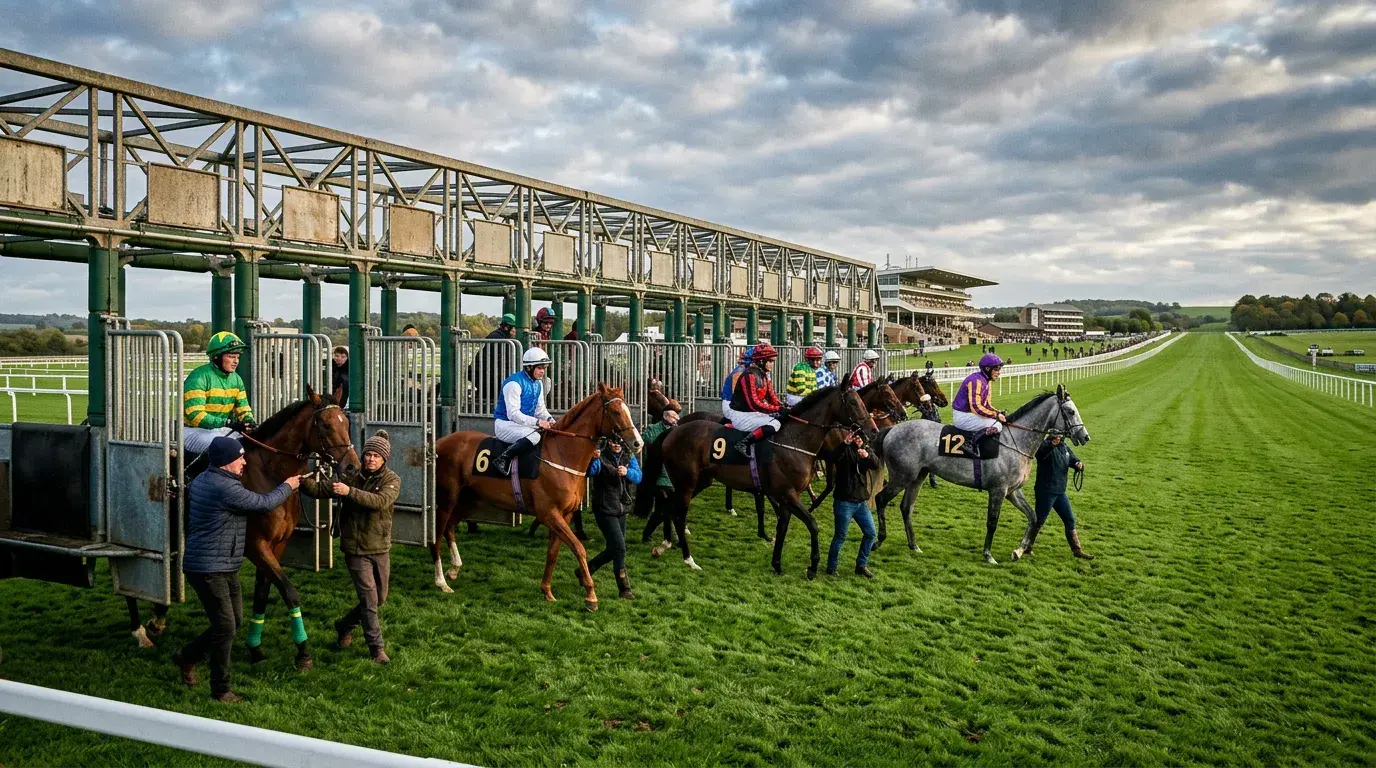
Fourteen of the last 23 Cesarewitch winners emerged from stall 13 or lower. That figure represents 61% of winners coming from the inside half of the draw, a pattern that persists across varying ground conditions, field sizes, and pace scenarios. For a race that regularly attracts 34 runners spread across the width of Newmarket’s Rowley Mile, starting position creates measurable advantage before the gates open.
The draw bias in the Cesarewitch stands in sharp contrast to its sister race in the Autumn Double. The Cambridgeshire Handicap, run over nine furlongs at the same course just weeks earlier, shows precisely the opposite tendency: eight of the last nine winners drew stall 21 or higher. Same track, different distances, inverted draw patterns. Understanding why these biases operate so differently unlocks the inside track to the winner’s enclosure.
Draw analysis often suffers from small-sample noise in racing, but the Cesarewitch provides unusually robust evidence. Twenty-three years of data across consistently large fields creates statistical weight that transcends seasonal variance. The low-draw advantage is not folklore passed between generations of punters. It is measurable reality grounded in the physical characteristics of the Rowley Mile straight and the tactical demands of marathon handicaps.
This analysis examines how the stall draw operates in big-field handicaps, why low draws specifically favour Cesarewitch contenders, and how bettors can incorporate draw position into systematic selection frameworks. The evidence points toward actionable filters that narrow 34-horse fields into manageable shortlists.
The draw advantage interacts with other established trends. Lightweights dominate, with 83% of recent winners carrying 9st 2lb or less. Horses aged four to seven account for 11 of the last 12 winners. When these factors align with favourable draw position, the statistical case for a horse strengthens considerably. Draw represents one element of a multi-factor framework, but an element with sufficient predictive power to shape betting approaches meaningfully.
How the Draw Works in Big-Field Handicaps
The Random Allocation System
The stall draw for British flat races operates through a random allocation system conducted by the British Horseracing Authority. Once entries are confirmed and final declarations made, horses are assigned starting positions through a blind draw supervised by officials. Connections have no influence over where their horse loads; the process aims to eliminate any possibility of manipulation while creating fair conditions across all runners.
In theory, randomisation should produce equal opportunity. A horse drawn one ought to have the same statistical chance of winning as one drawn 34. Practice tells a different story. Track configuration, distance, going conditions, and field size all interact to create biases that random allocation cannot eliminate. The draw assigns position; the racecourse determines whether that position helps or hinders.
The Rowley Mile Configuration
The Rowley Mile straight course presents specific characteristics that influence draw bias. Unlike circuit tracks where horses navigate bends, the Rowley Mile runs approximately straight from start to finish. However, the course does feature subtle undulations and a gentle camber that favours certain racing lines. Horses racing on the stands’ rail side often encounter firmer ground where the track receives less rainfall and drainage operates more efficiently. Horses on the far side may find softer going, particularly after autumn rain.
Field size magnifies draw effects exponentially. A race with 10 runners allows each horse ample room to find preferred ground and settle into rhythm without interference. A race with 34 runners creates congestion, kickback, and tactical compromises that begin from the moment the gates open. Horses drawn wide must either burn energy crossing to the rail or accept racing in air that costs ground throughout. Horses drawn low can establish position economically, conserving fuel for the final furlongs.
Distance Compounds the Effect
The Cesarewitch’s two-mile-two-furlong distance compounds these dynamics. Over shorter trips, early positional losses can be recovered through superior speed in the final furlong. Over marathon distances, every extra yard covered accumulates fatigue that manifests when stamina reserves deplete. A horse drawn 28 that races wide throughout may cover an additional 50 yards compared to one drawn 4 that hugs the rail. At the end of 18 furlongs, those extra yards often prove decisive.
The draw also interacts with pace scenarios. If the early pace develops on the stands’ rail, high draws may find themselves chasing from behind, unable to secure prominent positions without expending energy the distance demands they conserve. If pace develops on the far side, low draws might find themselves isolated, though historical evidence suggests this scenario occurs less frequently in the Cesarewitch than alternatives.
Technology has improved understanding of draw effects without eliminating them. Sectional timing data now allows precise measurement of how much ground each horse covers relative to the shortest route. Wide-drawn horses consistently travel further than rail-huggers, with differentials increasing over longer distances. The Cesarewitch’s marathon trip produces maximum divergence between theoretical race distance and actual distance covered by wide-racing runners.
The Low Draw Advantage
The Statistical Evidence
According to GeeGeez.co.uk, 14 of the last 23 Cesarewitch winners drew stall 13 or lower. This 61% strike rate from the inner half of the draw significantly exceeds what random distribution would predict. If draw position carried no predictive value, approximately half the winners would emerge from low stalls and half from high. The observed bias toward low draws indicates systematic advantage rather than variance.
Breaking down the data reveals clustering rather than uniform distribution across low draws. Stalls 1 through 6 have produced a disproportionate share of winners, suggesting that the advantage intensifies toward the rail rather than applying equally across all low positions. A horse drawn 5 enjoys greater edge than one drawn 12, even though both qualify as low draws under the threshold. When filtering for Cesarewitch selections, stalls in the single digits merit additional attention.
How the Advantage Operates
The low-draw advantage operates through several mechanisms. Horses drawn inside can settle on the rail immediately, avoiding the scramble for position that wide draws necessitate. They can track the pace without needing to make ground laterally. They can save lengths throughout the race by following the shortest available route. When the field begins to stretch in the final half mile, inside horses are already positioned to exploit gaps as tiring rivals drift off the rail.
Ground conditions interact with draw effects. Soft going, which frequently occurs at Newmarket in mid-October, tends to create variance across the track width. The stands’ rail, where low draws operate, often rides faster than the far side because drainage patterns concentrate moisture toward the centre and outer sections. A horse drawn low on soft ground thus enjoys both positional and surface advantages that compound throughout the race.
The long distance amplifies these effects relative to shorter races. Over six furlongs, a wide draw costs perhaps one or two lengths by the finish. Over 18 furlongs, the cumulative cost multiplies threefold or more. What amounts to minor inconvenience in sprints becomes significant disadvantage in staying handicaps. The Cesarewitch’s marathon trip maximises the penalty for unfavourable draw position.
Winner Profiles and Jockey Insights
Examining individual winners reinforces the statistical pattern. Low Sun won from stall 3. Sweet William from stall 7. Donatello Moon from stall 9. The occasional high-draw winner exists, but these horses typically possessed exceptional stamina that overcame positional disadvantage or benefited from unusual pace scenarios that drew the field wide. Such cases represent exceptions that prove the rule rather than evidence against low-draw advantage.
Jockeys confirm the preference for low draws when discussing Cesarewitch tactics. Riders drawn wide describe the race as requiring immediate tactical decisions: cross early and expend energy, or accept racing wide and hope stamina compensates. Riders drawn low speak of settling into rhythm and waiting for opportunities that the race’s length inevitably creates. The stress differential between these tactical frameworks favours low draws throughout.
Weather conditions on race day can moderate or intensify draw effects. Heavy rain that falls unevenly across the track may create pockets of better ground that override historical draw patterns. Wind direction and strength affect horses racing in exposed positions more than those sheltered behind others. However, these day-specific factors rarely reverse the underlying low-draw advantage entirely; they merely adjust its magnitude from race to race.
Pace and Positioning Analysis
Typical Race Shape
The Cesarewitch typically unfolds at a moderate early pace before accelerating through the final half mile. With 34 runners and two miles two furlongs to cover, jockeys understand that burning energy early invites disaster late. The race usually establishes a leading group of six to ten horses with the remainder settling in behind, conserving reserves for the closing stages. This pace pattern favours horses that can secure covered positions without using excessive effort.
Low draws facilitate this tactical approach. A horse leaving stall 4 can break and immediately slot in behind the early leaders while racing on the rail. The position provides cover from wind resistance, saves ground on every stride, and allows the jockey to observe the race unfolding ahead. High draws face more complicated early moments. A horse leaving stall 28 must either use energy to cross toward the rail or accept racing exposed for an extended period.
Straight Track Dynamics
The Rowley Mile straight track creates specific pace dynamics. Without bends to navigate, the field can spread across the course width more easily than on circuit tracks. This spreading tends to occur after the first quarter mile as runners settle into their preferred positions. Horses that can establish rail position before the spreading occurs gain lasting advantage; those caught wide when the field disperses face a long afternoon.
Pace scenarios do occasionally develop that favour wide draws. If a prominent runner drawn high sets a strong pace on the far side, other horses may be drawn out to follow, leaving inside horses isolated and potentially struggling to get involved. However, historical evidence suggests these scenarios occur infrequently in the Cesarewitch. Most runnings see the stands’ rail group dominate, with far-side runners gradually drifting toward the main cluster as the race progresses.
The Closing Stages
The race’s second half determines outcomes. By the time horses pass the halfway point, positions are largely established and the question becomes which animals have conserved sufficient energy for the final push. Horses that raced wide throughout have already depleted reserves that rail-racing rivals still possess. The closing sectionals typically favour those who saved ground earlier, and those horses disproportionately drew low.
Trainer tactics reflect this understanding. Trainers with low draws often instruct jockeys to hold position and wait, knowing the draw provides inherent advantage. Trainers with high draws must choose between aggressive early tactics that risk burnout or patient approaches that surrender positional edge. Neither option is comfortable, which explains why high draws win less frequently despite similar quality of entrants.
The final two furlongs produce most Cesarewitch drama. Tired horses begin to drift, gaps appear, and those with remaining stamina accelerate into them. Low-drawn horses that followed the rail find those gaps opening ahead of them. High-drawn horses may find gaps appearing but must navigate lateral traffic to reach them. The geometry consistently favours inside positions.
Historical race replays confirm these tactical patterns. Watching ten years of Cesarewitch finishes reveals consistent themes: winners emerging from covered positions having saved ground, placed horses that raced wide throughout exhausting their reserves before the winning post. The visual evidence aligns with statistical evidence to present a coherent picture of why draw matters over this specific distance on this specific course.
Field Size Impact on Draw Bias
How Field Size Affects Draw
The Cesarewitch’s draw bias intensifies as field size increases. In years when 34 runners line up, the advantage of low draws reaches maximum expression. In years when the field drops to 25 or below, the bias moderates because additional space reduces congestion that penalises wide positions. Bettors should calibrate draw filters according to declared field size, strengthening the low-draw requirement when maximum fields assemble.
The Cambridgeshire Contrast
Comparing the Cesarewitch with the Cambridgeshire illuminates how field configuration affects draw dynamics. According to Sportscasting UK, eight of the last nine Cambridgeshire winners drew stall 21 or higher. This high-draw advantage represents almost the exact inverse of the Cesarewitch pattern. Both races occur at Newmarket, both attract maximum fields, yet their draw biases point in opposite directions.
The explanation lies in distance and track section. The Cambridgeshire covers nine furlongs from a different starting point, utilising a section of the Rowley Mile where historical ground bias favours the far side. The Cesarewitch’s two-mile-two-furlong trip begins elsewhere and takes runners through different terrain. Same racecourse, different biases, depending on which portion of the course the race traverses and how long horses must endure positional disadvantage.
Pace and Industry Context
Field size also interacts with pace predictability. Larger fields create more uncertainty about where pace will develop. With 34 runners, multiple horses may attempt to lead, creating bunches rather than strings. Low draws benefit from this clustering because inside positions provide shelter regardless of which subset of the field pushes forward. Smaller fields often produce more straightforward pace scenarios where a single clear leader emerges, reducing the protective value of inside positions.
“We are all very conscious of the fact that the sport is facing quite significant headwinds,” noted Richard Wayman, Director of Racing at the BHA, in comments to Racing Post. “You can make some very sensible fixture list changes that in themselves are positive and making positive contributions, but that does not necessarily mean they cancel out all of the headwinds that the sport is facing.” While Wayman addressed broader industry challenges, his observation about headwinds applies literally to horses drawn high in large Cesarewitch fields. They face headwinds both meteorological and competitive, disadvantages that compound over marathon distances.
Withdrawals and Adjustments
Withdrawals after declaration affect draw analysis. A horse originally drawn 20 might find its effective position improved if several lower-drawn rivals scratch. Post-declaration non-runners do not trigger restalls; horses keep their original draw numbers but race against a smaller field. Monitoring withdrawals becomes essential because a seemingly poor draw might become acceptable once the field shrinks and congestion decreases.
The 34-runner maximum represents regulatory capacity rather than optimal field size for competitive balance. Heritage handicaps attract entries precisely because their prestige justifies the challenges of large-field racing. But those challenges fall disproportionately on wide-drawn horses, creating systematic advantage for those fortunate enough to land low stalls. The draw contains randomness; its effects do not.
Draw-Based Betting Strategy
Applying Draw Filters
Incorporating draw analysis into Cesarewitch betting requires balancing statistical evidence with practical flexibility. The 14-of-23 low-draw success rate provides compelling reason to favour horses drawn 13 or below, but rigid adherence to any single filter ignores the complexity of 34-runner handicaps. Draw represents one factor among several; it should inform selections without dictating them absolutely.
Begin by eliminating horses with severely disadvantageous draws. Stalls 25 and higher historically produce very few winners, making horses drawn in this range difficult to justify in win-focused betting. Each-way considerations differ slightly because place terms extend to six or seven runners, meaning a high-draw horse might place despite lacking winning credentials. Still, prioritising low draws produces better expected value across most betting frameworks.
Combining Multiple Factors
Combine draw filtering with weight analysis for compound edge. According to Sportscasting UK, 83% of recent winners carried 9st 2lb or less. When a horse carries light weight and draws low, two independent positive factors align. The statistical foundation strengthens because the horse satisfies multiple winning criteria rather than just one. A horse drawn 6 with 8st 10lb offers structurally better prospects than one drawn 22 with the same weight or one drawn 6 with 9st 12lb.
Age provides a third filter layer. Eleven of the last 12 winners fell within the four-to-seven age bracket. A five-year-old carrying 8st 12lb from stall 7 checks three historical boxes simultaneously. Such horses may still lose, but they compete from positions of accumulated advantage that horses failing multiple filters cannot match. Systematic selection means stacking probability in your favour through converging evidence.
Market Dynamics and Timing
Market prices interact with draw value. Low-drawn horses sometimes attract market support precisely because other bettors recognise the draw advantage. When a low-draw horse trades at shorter odds than its form warrants, the draw benefit may already be priced in. Conversely, a well-drawn horse from an unfashionable yard or featuring unfamiliar Irish form might trade at prices that fail to reflect positional edge. Seek low draws at value prices rather than simply backing every low-drawn runner regardless of odds.
Monitor declarations and late withdrawals. The draw’s significance can shift between initial publication and final confirmation. If multiple low-drawn horses scratch, remaining low-draw survivors face less inside competition. If high-drawn horses withdraw, the field compresses and draw bias may moderate. Flexible approaches that reassess after final declarations outperform rigid strategies that ignore late changes.
Each-Way and Ante-Post Considerations
Each-way betting amplifies draw’s importance. Place terms in 34-runner fields typically pay six or seven positions, meaning horses that frame without winning still generate returns. Low-drawn horses place at rates exceeding their odds because they consistently get into contention even when falling short of victory. Backing low draws each-way captures this place strike rate while retaining upside from occasional winners at double-figure odds.
Final selections should pass multiple filters rather than relying on draw alone. The ideal Cesarewitch selection combines low draw with light weight, optimal age, proven stamina, and trainer credentials suggesting genuine preparation. When all factors align, confidence increases appropriately. When only draw favours a horse while other factors raise concerns, caution should prevail. Draw provides edge; it does not guarantee success.
Ante-post betting complicates draw application because stall positions remain unknown until declaration day. Punters taking early prices cannot know whether their selection will draw favourably. This uncertainty creates risk but also opportunity: horses that subsequently draw low may drift in ante-post markets from punters unaware of the draw’s importance, then shorten post-draw as the advantage becomes apparent. Timing bets around draw publication can capture additional value.
The draw filter works best as a disqualification tool rather than a selection tool. Rather than backing every low-drawn horse, use the draw to eliminate high-drawn contenders from serious consideration. Then apply form analysis, trainer assessment, and other factors to the remaining pool of low-drawn candidates. This approach combines statistical edge with traditional handicapping methods for balanced selection frameworks.
